Oct 8, 2026
Press
WASHINGTON, D.C. — Today, Rep. Marie Gluesenkamp Perez (WA-03), joined a House Committee on Natural Resources hearing concerning sea lion predation in the Pacific Northwest. Rep. Gluesenkamp Perez is not a permanent member of this committee, but participated in today’s hearing given the urgent need to remove California and Steller Sea Lions in the Columbia River and its tributaries.
Salmon and steelhead in Washington and Oregon currently face a severe threat of predation by California and Steller Sea Lions. With current removal options failing to keep the pinniped population in check, Rep. Gluesenkamp Perez engaged the witnesses on the viability of expanding direct-kill strategies and expanding take permit partnerships.
“When Congress amended the Marine Mammal Protection Act to expand lethal removal authorities, it provided that eligible managers along the Columbia River could remove up to 450 California Sea Lions and 176 Steller Sea Lions during the five year life of the take permit. We haven’t even seen them come close to reaching these levels,” said Rep. Gluesenkamp Perez.
“Ask yourself, why? Why are these numbers so small?” she continued. “The arduous process of removal is a key feature […] the cost and the onerous back and forth of trapping the creature, identifying its threat, shaking a can of pennies at it, retrapping and then finally darting, contribute heavily. We’ve done some back of the envelope math to try and determine the cost to remove sea lions under the permit. From our estimates, it costs over $38,000 per removal from the Columbia River. That’s roughly $203 per salmon saved in state and taxpayer federal dollars.”
Click HERE to watch Rep. Gluesenkamp Perez’s full questions.
Rep. Gluesenkamp Perez recently called on the National Oceanic and Atmospheric Administration (NOAA) to continue pinniped predation mitigation efforts on the Columbia River and examine best practices for sea lion removal, including direct, lethal removal and secured language in the FY26 Commerce, Justice, and Science Appropriations Bill (see page 26) in pursuit of that same goal.
She has also joined local fishermen on the Columbia River to discuss sea lion population control methods and toured the Bonneville Dam sea lion management program.
A full transcript of Rep. Gluesenkamp’s questions and the witness’s answers can be found below:
Rep. Gluesenkamp Perez:
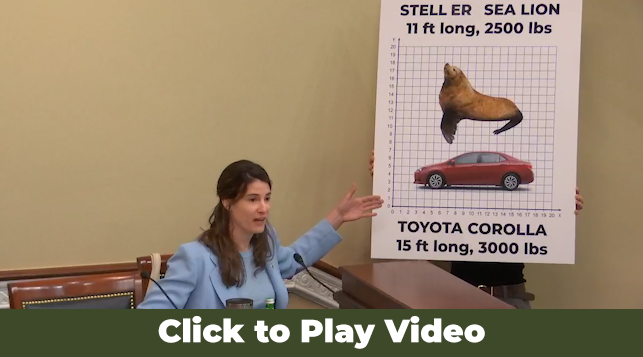
So I live right above the Columbia River in Southwest Washington, just above the Bonneville Dam, and I have seen and heard firsthand how much work goes into managing sea lion populations and preserving local fisheries and tributaries. As the name implies, sea lions are a species that belong in the sea, not in our rivers. A sea lion is not a small creature for scale, please note the Toyota Corolla. A Steller Sea Lion is 11 feet long and 2500 pounds. These are behemoths and Toyota Corolla 15 feet and 3000 pounds. And when Congress amended the Marine Mammal Protection Act to expand lethal removal authorities, it provided that eligible managers along the Columbia River could remove up to 450 California Sea Lions and 176 Steller Sea Lions during the five year life of the take permit. We haven’t even seen them come close to reaching these levels. In 2024 only 27 California and 21 Steller Sea Lions were removed at Bonneville Dam. As of July this year only 26 and 11 have been removed. Ask yourself, why? Why are these numbers so small? The arduous process of removal is a key feature. I’m concerned that the factors contributing to this severe utilization, namely the cost and the onerous back and forth of trapping the creature, identifying its threat, shaking a can of pennies at it, retrapping and then finally darting, contribute heavily. We’ve done some back of the envelope math to try and determine the cost to remove sea lions into the permit. From our estimates, it costs over $38,000 per removal from the Columbia River. That’s roughly $203 per salmon saved in state and taxpayer federal dollars. I was successful in including language in the FY 26 Commerce, Justice and Science Appropriations report that passed out of committee that would direct your agency to conduct a study on the most effective strategies for pinniped removal considering factors such as animal health and cost. So my question to you, Mr. Rauch, could you tell me more about what NOAA is actively doing to ensure that current pinniped removal strategies are the most effective and if direct kill strategies are being considered?
Mr. Sam Rauch:
Thank you for the question. Yeah, the current permits, as you indicate, do authorize direct mortality removals, and we do think that in the Pacific Northwest, for these species, that is the most effective way we have tried over the years to employ non lethal removals. We have moved them hundreds of miles away, and they do come back.
Rep. Gluesenkamp Perez:
Faster than the people taking them out.
Mr. Sam Rauch:
Perhaps. They do come back. They are remarkably resilient, and they do know where their food source is. It is very difficult to encourage them to leave with anything less than force. At one point, we did try to find space in zoos and aquariums, but that rapidly filled up. So there is no, in our opinion, currently better way to address predation other than lethal removal.
Rep. Gluesenkamp Perez:
Yeah, thank you for that insight. Has NOAA looked into the potential challenges to removal efficacy posed by current permit requirements, such as the requirement for the sea lion to be individually identified and observed eating fish before they can be removed?
Mr. Sam Rauch:
I think we have said in prior testimony, and I indicated earlier today that is a very cumbersome provision that does not exist currently on the Columbia River, and it makes the Columbia River because they don’t have to do that. That is a more effective program.
Rep. Gluesenkamp Perez:
And, and, and yet, I think we’re seeing that we’re still not able to exercise those permits. And I would say to my fellow committee members, you know, this is local lore. This is one of the things I hear about all the time. I don’t have air conditioning in my elementary schools. And to see the cost and expense gone through and the levels of ologists we have to go through to protect our you know, our reliance on salmon, it’s well know. In living memory, there are people in my family who live because their daddies were good fishermen. And it’s not, it’s not a it’s we’re very concerned at the lack of efficacy of the current removal process. So thank you for your work on this.
Chairman Choke in your testimony, you mentioned the need for Congress to streamline Section 120 process to allow managers to remove pinnipeds by means not limited to chemical euthanasia. Could you provide some examples or strategies other than traps in chemical euthanasia? It that you believe would be more effective in removing or deterring sea lions?
Chairman Ken Choke:
Thank you for that question. Initially, it’s something that we need to continue to take a look at and see how we can evaluate the situation, and as I stated earlier, come up with less lethal means. I guess you could say, you know, I’ve always stressed the point, how can we actually, you know, resolve the issue with our pennipets and the harbor seals? One of the things we need to take and consideration is the simple fact that, you know, in Alaska, they do harvest such animals. So can we work together with our brothers and sisters up north to do what we’ve done in traditional ways and barter with our brothers and sisters up north? And, you know, and they’re, they’re salmon abundance up there? But initially it’s collaboration, working with Chairman John Stone and our state and federal partners to come up with a resolution to that. So thank you for that question.
Rep. Gluesenkamp Perez:
Thank you. Thank you for that response. Mr. Phillips, I’m curious to hear just some some brainstorming. I’ve been chewing on this for a while and hearing a lot from my community about this. And I’m curious to hear what you might think about a permit auction process or a lottery, some kind of guide, some process where local fishermen and tribal members could bid on permits to assist with lethal removals. I’ve had so many people tell me they would pay good money, and with funds coming far short in our rural schools, another revenue source and a broader tie to the community that this is, this is a bigger part of our life than just eating. So, you know, yeah, what are your thoughts? I understand there are a lot of points to flesh out here, but I wanted to bring it up in a possible step in the right direction?
Mr. Larry Phillips:
Yeah, I hadn’t heard that one, but I’m sure there were folks would line up to participate in that. I think we need to be creative. I think we need to find tools to address the challenge. You know? I also think that we need to be really careful make sure we’re investing in good science to monitor the outcomes of any type of programs that we implement or decide to implement, and that’s that clearly is going to be the foundation of how we move forward. But you know, I would certainly support being creative and coming up with unique ideas.
Rep. Gluesenkamp Perez:
We got unique ideas over here.
Mr. Larry Phillips:
I still can’t. I can’t even harvest an elk, so I probably wouldn’t.
Rep. Gluesenkamp Perez:
Ms. DeCoteau I appreciate you being here to speak directly on the complex challenges to mitigating issues at the Bonneville Dam, but I’d like to hear more about your perspective on expanding section 120 F permits to the tributaries, and how this might help deter sea lions more effectively.
Ms. Aja DeCoteau:
Yes, thank you for the question. Absolutely. I think what we see on top of the bottlenecks is these confluence of animals around tributaries coming into the main stem of the Columbia River. So I think the more we can again, this is learned behavior, the more we can disrupt this learned behavior earlier, near the estuary and coming into the Columbia River, that will prevent them from coming all the way into the lower river and into Bonneville Dam.
Rep. Gluesenkamp Perez:
Yeah, that’s, that’s a lot of what I heard is this is learned behavior, and you have to without any, without any clear feedback loop here. You know, being, being direct, and being, I think, respectful, and communicating, not with, as Mr. Johnstone was saying they don’t read the laws, but to communicate more clearly. So thank you for your insight, thank you for your work, and I’ll yield back.
###